

Binaural, monaural or isochronic: which one does the brain follow?
Three ways to put a pulse in your ears, and the evidence for choosing between them. The one direct EEG comparison found the pulsed tone moved brain rhythms most, and plain white noise moved them too.
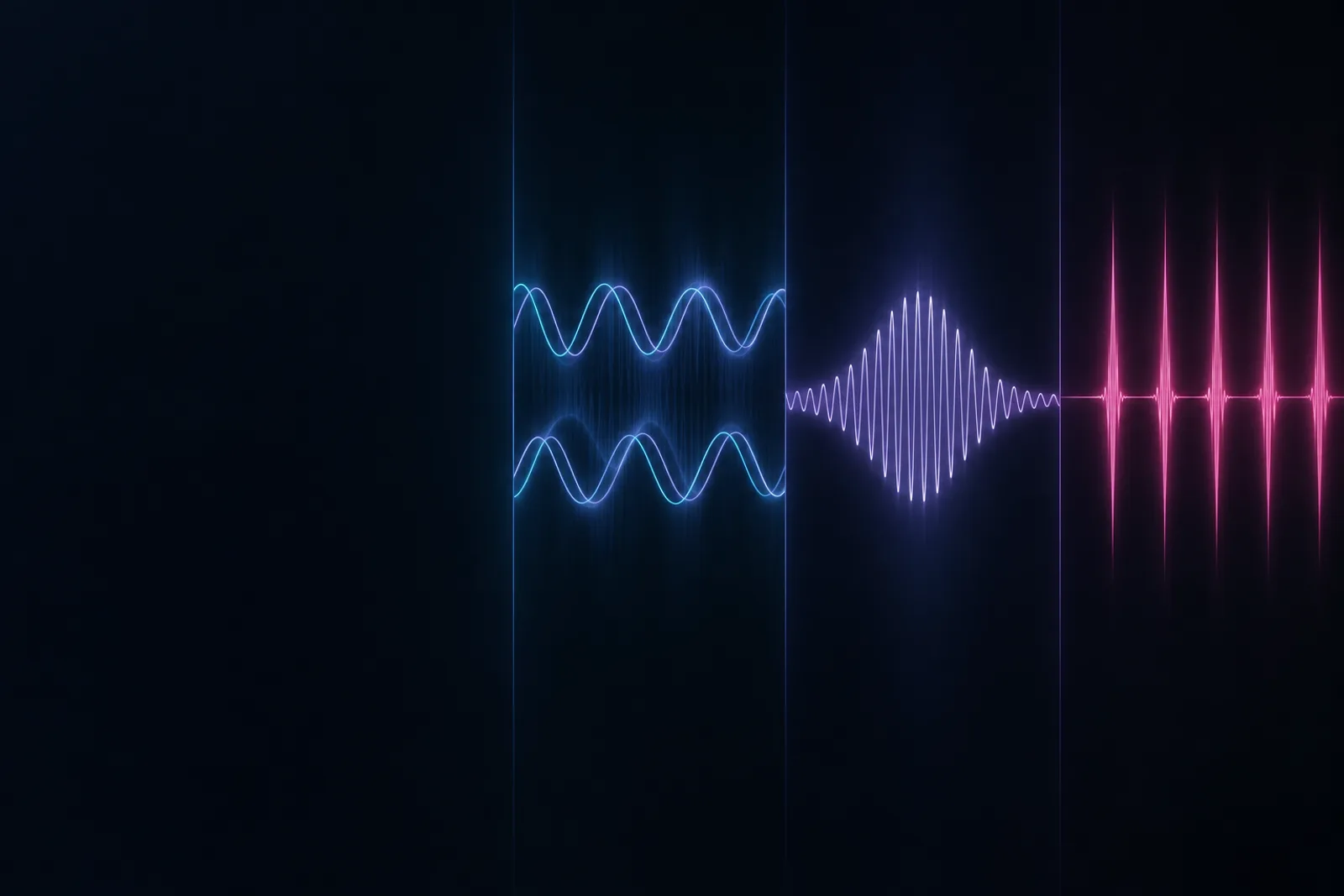
There are three common ways to put a rhythmic pulse into your ears, and the apps will tell you one of them is best. Nobody has tested all three against each other. The closest anyone has come put binaural beats against a pulsed tone and plain white noise in twenty-eight people, with no monaural arm at all. The winner wasn’t binaural beats. It was the pulsed tone. And the white noise moved brain rhythms too, which tells you something about how much any of this means.
Binaural beats are the only one of the three that needs headphones, because they’re the only one that doesn’t exist in the air. They’re also the most studied by a wide margin, which isn’t the same as the best supported. If you only ask which stimulus shifts the EEG most, the evidence points to isochronic-style pulsed tones, from one small study that contained no monaural beats. If you ask which one changes anything you’d notice, there’s a single comparison: a pilot in fifteen epilepsy patients who already had electrodes in their heads, where binaural beats came out above silence on a memory task and monaural beats below it. Our grade for the comparison is weak.
What the three things actually are
The differences are physical and easy to describe.
Binaural beats. Two steady tones close in frequency, one to each ear. Play 300 Hz on the left and 303 Hz on the right and you hear a 3 Hz pulsing that’s in neither signal. Your head makes it, at the first place in the auditory pathway that gets input from both ears. So headphones aren’t a preference here. They’re the mechanism. Out of a speaker the two tones mix in the air before they reach you, and you get something else.
Monaural beats. The same two tones, added together before they reach you, so the swelling and fading is already in the waveform. Your eardrum moves with it. Speakers are fine. One ear is fine.
Isochronic tones. A single tone switched on and off at a set rate: hard edges, silence between pulses, no second tone. Also fine on speakers.
If a track is described as binaural, you need headphones. If it’s monaural or isochronic, you don’t. The beat is already in the sound, so it works through speakers or headphones, and an app that tells you headphones are required is underselling itself.
The one direct comparison
Dos Anjos and colleagues recorded EEG from twenty-eight people through four minutes each of gamma-frequency binaural beats, a newer isochronic-style pulsed tone, and plain white noise. All three raised gamma-band power. The pulsed tone produced the largest increase, and it kept climbing across the four minutes where the binaural condition levelled off. It also did something the others didn’t: alpha power fell steadily while it played. The authors read that alpha-down, gamma-up pattern as a signature worth pursuing.
Look at the white noise before the ranking. A sound with no beat frequency in it at all raised gamma power, so part of what every one of these stimuli does is simply be a sustained sound in your ears. And twenty-eight people in one four-minute session, with no behavioural outcome and no replication, is thin. It’s the best direct comparison there is.
The literature is lopsided, which is easy to mistake for a finding
When Aparecido-Kanzler, Cidral-Filho and Prediger went looking for controlled trials of audio entrainment, they screened 674 records down to thirty-three randomised trials, seventeen of which passed their quality filter. Fifteen of those seventeen used binaural beats. Two used isochronic tones.
Keep that ratio in mind whenever someone compares the three. Claims that isochronic tones work better rest on about two decent trials. Claims that binaural beats are better supported are true only in the sense that more people have studied them, and that’s a statement about researchers, not about ears. Monaural beats have had the least attention of all as a standalone intervention.
Venkatesan and colleagues ran the one substantial monaural study we hold. They randomised 308 people to thirty minutes of monaural beats woven into music, the same beats on their own, or a plain tone. Only the beats-in-music group ended up less anxious, by a medium-sized amount. The beats-alone group didn’t improve, and reported slightly less energy afterwards. There was no music-without-beats arm, so the study can’t say whether the beats added anything to the music that carried them. But the pleasant sound was clearly doing work the bare beats weren’t.
A problem that sits underneath the comparison
Asking which stimulus the brain follows best assumes we can measure following. We mostly can’t, not cleanly.
Duecker and colleagues’ methods review sets out the core difficulty. A brain producing a fresh evoked response to each pulse makes a scalp signal that can look exactly like an ongoing oscillation being pulled into step. Telling the two apart takes tests most studies don’t run, such as checking whether the rhythm outlasts the sound. A peak in the EEG at the beat frequency isn’t, on its own, evidence of entrainment in the strong sense product copy means.
Ávila’s 2026 study shows how much that can matter. Ávila tested binaural beats added to a flickering light at 8, 20 and 40 Hz, and the beats strengthened the rhythmic response at 8 and 20 Hz. At 40 Hz, standard spectral analysis showed more gamma activity, and the rhythmic enhancement disappeared once the truly rhythmic part of the signal was separated from the broadband background. What changed at 40 Hz was the background. That isn’t entrainment, and a great many 40 Hz audio claims rest on exactly the measurement that study took apart.
Which makes the dos Anjos ranking harder to read. The pulsed tone moved measured power most. Whether it moved rhythm most is a separate question, and that study didn’t separate the two.
The 1970s set a boundary that still holds
Two old papers mark where binaural interaction happens and where it doesn’t. Both get cited loosely.
Gerken and colleagues recorded the brainstem’s frequency-following response in five listeners, playing a 500 Hz tone to one ear and then to both. The binaural response was the straightforward sum of the two monaural responses: two independent populations of neurons, one per ear, neither interacting with the other. The frequency-following response is the measure people usually invoke when they say audio entrains the brainstem. At that level the ears weren’t combining at all.
Four years later Kuwada, Yin and Wickesberg recorded single neurons in the cat inferior colliculus firing in step with a binaural beat. That’s the clearest account we have of why you hear the pulse, and it sits higher up the pathway than the frequency-following response. Their paper was about how animals locate moving sounds, which is what a beating pair of tones imitates.
Then there’s Gerald Oster’s 1973 Scientific American essay, the citation almost every product page uses. It’s also where the monaural and binaural distinction was first laid out carefully. Oster reported that the two produce evoked potentials differing in amplitude, waveform and timing, and he read that as processing at different sites. He also found that binaural beats fade as the carrier tone rises: indistinct above roughly 440 Hz, inaudible to his listeners by about 900 Hz. If you’re choosing a binaural track, that’s a real constraint, and you’ll rarely see it mentioned. The effect depends on a low carrier. Oster proposed binaural beats for neurological diagnosis. His essay says nothing about relaxation, focus or sleep.
The one head-to-head test on something you would notice
Everything above measures brain signal. Only one study has compared binaural and monaural beats on a behavioural outcome, and it’s a pilot. Derner and colleagues worked with fifteen patients being assessed before epilepsy surgery, who already had depth electrodes in the hippocampus and rhinal cortex. They played 5 Hz monaural beats, 5 Hz binaural beats or a control condition while the patients worked through an associative learning task scored for both item and source memory. Performance came out in the order binaural, then control, then monaural (Frontiers in Human Neuroscience, 2018), with a main effect of stimulation at p = 0.03 and a linear trend in that order at p = 0.036. Binaural beat the control condition. Monaural did worse than it.
Don’t lean on that ranking. Fifteen people is a pilot, and the authors say so in the title. Patients with electrodes implanted for epilepsy surgery aren’t a general population, and a laboratory recognition task isn’t something you’d notice while you work. The same group later looked at single-neuron firing in a subgroup of these patients and read the behavioural split as a shift in baseline firing rates rather than entrainment. So the field has asked this question once, in fifteen people, under conditions nobody would choose. We haven’t graded the study into the library, so it carries no grade of ours here.
One study where the type of sound mattered, in the opposite direction
The largest relevant experiment anyone has run wasn’t designed as a comparison, and it produced one anyway. Klichowski and colleagues had 1,000 adults take a reasoning test at home in two matched halves, with audio playing for the second half. Both 5 Hz and 15 Hz binaural beats lowered scores by 5 to 7 per cent, while silence, classical music and a 240 Hz pure tone produced no significant change.
A pure tone is a very similar thing to listen to, and it cost nothing. The authors’ own guess is distraction rather than neurology, though they note the pure-tone result makes distraction an awkward explanation. Either way, in the one well-powered test of doing cognitive work with audio playing, the beat was the version that hurt. The plain tone wasn’t. That’s a sound-type difference, and it runs opposite to how the three are marketed.
What this means if you use them
You can’t choose between these three on effectiveness, because the comparison has barely been run: one EEG study without a monaural arm, and one fifteen-person pilot in epilepsy patients. What the evidence does support is narrower, and more useful:
- Headphones matter for binaural beats and not for the other two. That’s mechanics, not marketing.
- Binaural beats need a low carrier tone. The pulse weakens as the underlying pitch rises.
- Any sustained sound shifts the EEG somewhat, white noise included, so a graph showing your brainwaves changed isn’t evidence that the beat frequency did it.
- The strongest evidence in this whole field isn’t about stimulus type. It’s about anxiety before and after surgery, where a meta-analysis of fifteen randomised trials found a large effect. Those trials used binaural beats because that’s what researchers reach for, not because anyone showed the alternatives work less well.
- If a pleasant sound helps you settle or concentrate, that’s a real thing to notice about yourself. In the monaural study, the music did more than the beats. None of this is medical advice, and nobody should treat a condition with any of these.
Our grade for the comparison is weak. One direct EEG study in twenty-eight people had no monaural arm, the only behavioural comparison is a fifteen-person pilot on a memory task, the trial literature splits fifteen to two toward the most-studied option, and it’s still an open question whether the measurement used to rank them measures the right thing.
Sources
- Dos Anjos and colleagues, 2024, Neuroscience. The EEG comparison of binaural beats, a pulsed tone and white noise, in twenty-eight people. No monaural arm. doi:10.1016/j.neuroscience.2024.07.014 · our summary
- Derner and colleagues, 2018, Frontiers in Human Neuroscience. The only behavioural comparison of monaural against binaural beats: fifteen presurgical epilepsy patients, item and source memory. Not yet in our library. doi:10.3389/fnhum.2018.00500
- Aparecido-Kanzler, Cidral-Filho and Prediger, 2021, Revista Mexicana de Neurociencia. Systematic review of 33 randomised trials. doi:10.24875/rmn.20000100 · our summary
- Venkatesan and colleagues, 2025, Frontiers in Psychology. Monaural beats in music, 308 participants. doi:10.3389/fpsyg.2025.1539823 · our summary
- Duecker and colleagues, 2024, Journal of Neuroscience. Methods review on what entrainment evidence requires. doi:10.1523/JNEUROSCI.1234-24.2024 · our summary
- Ávila, 2026, Neuroscience. Binaural beats with visual flicker at 8, 20 and 40 Hz. doi:10.1016/j.neuroscience.2026.10.013 · our summary
- Klichowski and colleagues, 2023, Scientific Reports. 1,000 adults, home use, reasoning scores. doi:10.1038/s41598-023-38313-4 · our summary
- Gerken and colleagues, 1975, Electroencephalography and Clinical Neurophysiology. Monaural and binaural frequency-following response. doi:10.1016/0013-4694(75)90262-X · our summary
- Kuwada, Yin and Wickesberg, 1979, Science. Single neurons following a binaural beat. doi:10.1126/science.493964 · our summary
- Oster, 1973, Scientific American. Where the monaural and binaural distinction was set out. doi:10.1038/scientificamerican1073-94 · our summary
Related articles

40 Hz sound and Alzheimer's: the evidence ladder
Strong results in mice, nine aged monkeys, and one 76-person sham-controlled trial that missed its primary endpoint. The pivotal trial…
Do binaural beats work? An evidence scorecard by outcome
The honest answer depends entirely on what you want them to do. Strong evidence for anxiety before surgery, weak for everyday calm…
The Science and Practice of Sound in Meditation: From Ancient Chanting to Modern Brainwave Entrainment
From Tibetan singing bowls and chant to gong baths and binaural beats: how sound is used in meditation, and what research says about why…